Compound Interest: How It Works and Why It Makes Such a Big Difference to Your Money


Compound Interest: How It Works and Why It Makes Such a Big Difference to Your Money
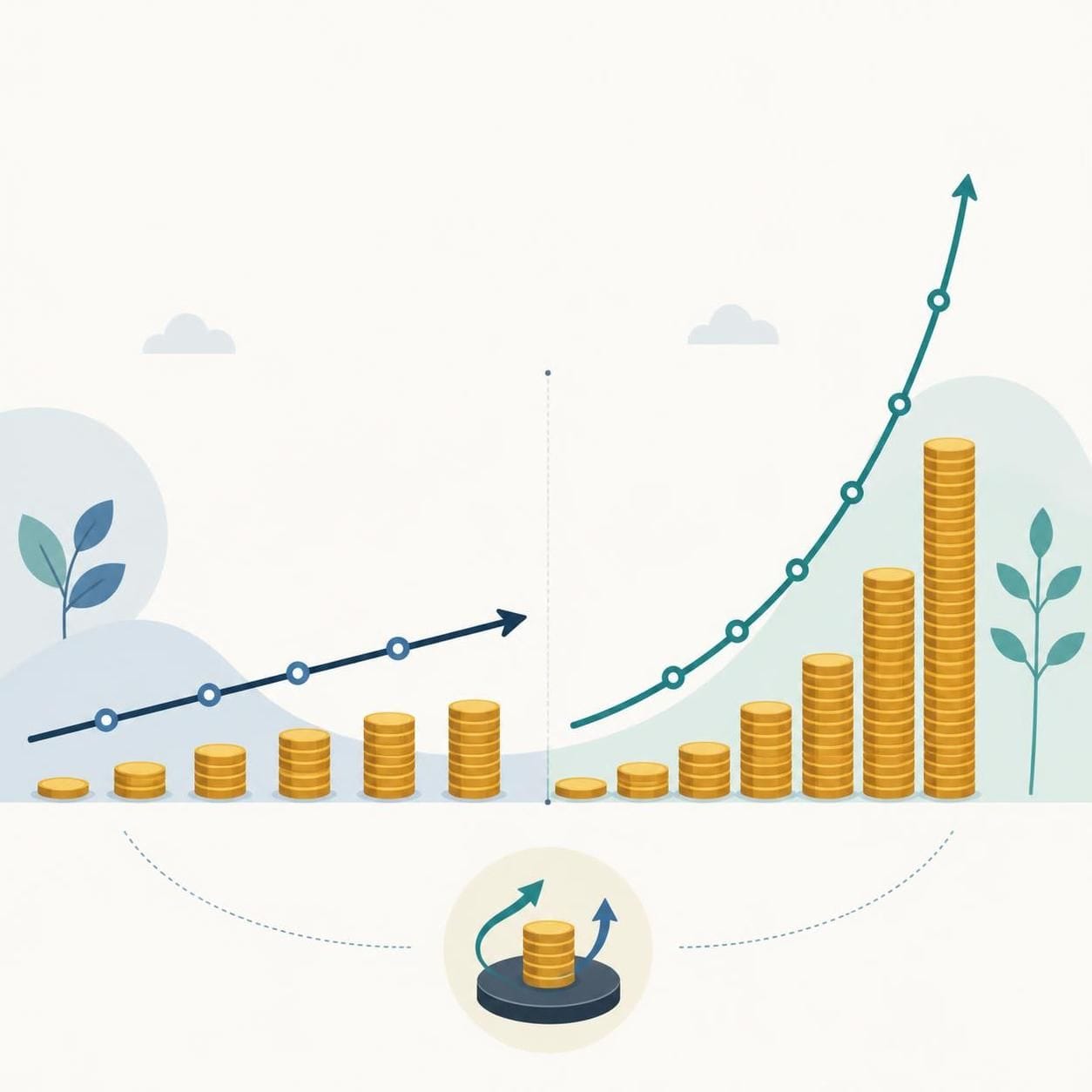
Compound interest is interest that accrues not only on the initial amount, but also on the interest that has already accumulated. In other words: it's interest on interest. That's why it's considered the engine behind long-term investment growth — and also the mechanism that makes debt grow fast when you don't keep it under control.
In this article, you'll understand how compound interest works, see how it differs from simple interest, follow numerical examples, and learn why time is the most powerful ingredient in this equation — for better and for worse.
Simple interest vs. compound interest
The difference between the two models lies in what the interest is calculated on:
- Simple interest: always calculated on the initial amount. If you invest R$ 1,000 at 1% per month with simple interest, you earn R$ 10 every month, always on the same R$ 1,000.
- Compound interest: calculated on the total accumulated balance. In the first month, the R$ 10 is on R$ 1,000; in the second, on R$ 1,010; in the third, on R$ 1,020.10 — and so on.
At first, the difference seems small. Over time, it becomes enormous, because the base on which interest is calculated keeps growing.
The compound interest formula
The standard compound growth formula is:
M = C × (1 + i)^t
Where:
- M = final amount
- C = initial principal
- i = interest rate per period (written as a decimal; 1% = 0.01)
- t = number of periods
One essential detail: the rate and the time must be in the same unit. If the rate is monthly, the time must be in months. If the rate is annual, the time must be in years. Mixing units is one of the most common mistakes people make when doing these calculations by hand.
Practical example: R$ 1,000 at 1% per month
Here's how the balance evolves with compound interest, with no additional contributions:
| Month | Balance (R$) | Interest for the month (R$) |
|---|---|---|
| 0 | 1,000.00 | — |
| 12 | 1,126.83 | 11.27 |
| 24 | 1,269.73 | 12.70 |
| 60 | 1,816.70 | 18.17 |
(Illustrative calculation using a fixed rate of 1% per month, solely to demonstrate the mechanics. It does not represent any specific product and does not guarantee returns.)
Notice: in month 60, the monthly interest (R$ 18.17) is already about 80% higher than the interest in the first month (R$ 10). Nothing changed in the rate — what changed is the base on which it accrues. That's what defines compound growth.
Where compound interest shows up in practice

Investments
Fixed-income products such as CDBs (bank deposit certificates) and Treasury Direct government bonds compound interest on interest, each with its own specific characteristics. The traditional savings account (poupança) also compounds monthly; its yield follows a rule defined by law (adjusted in 2012) and can vary according to the benchmark interest rate and the TR reference rate.
Some points to consider when comparing any investment:
- Issuer risk: with a CDB, there is the issuer's credit risk. Brazil's deposit insurance fund (FGC — Fundo Garantidor de Créditos) covers amounts within specific limits and conditions — this does not mean the investment is risk-free.
- Liquidity: how long it takes to withdraw the money without losses or lock-up periods.
- Taxes: income tax applies to the earnings of most fixed-income products, generally at rates that decrease as the holding period increases.
- Inflation: the nominal return is not the same as the real gain. The real gain subtracts inflation over the period. An investment that returns 8% in a year with 5% inflation had a much smaller real gain.
Debt
Here, compound interest works against you. On credit card revolving balances and overdraft facilities, interest compounds and the debt can grow rapidly if it isn't paid off. These are among the highest rates in the credit market — check the Central Bank of Brazil's updated data for current figures.
It's worth noting that, since Constitutional Amendment 128/2022, revolving credit card interest cannot exceed the original debt amount — but even with this cap, the debt can double within a few months. If you're in this situation, the path forward is to prioritize paying off your most expensive debts before thinking about investing. The guide on how to get out of debt on a low income can help with that step.
Why starting early makes such a big difference
Time is the factor that most amplifies compound growth. As an illustration, consider two people who invest R$ 300 per month at a hypothetical rate of 0.8% per month:
- Ana starts at age 25 and contributes until age 35 (10 years of contributions), then lets the money grow until age 60.
- Bruno starts at 35 and contributes until 60 (25 years of contributions).
Even though she contributes for half as long, Ana tends to accumulate more than Bruno, because her money stays exposed to compounding for far longer. (Illustrative simulation with an assumed fixed rate; it does not constitute a guarantee of returns or a product recommendation. Actual results depend on the effective rate, inflation, and taxes over the period.)
The practical lesson: the best day to start was yesterday; the second best is today. And if you're taking your first steps, the guide on how to start investing and the article on how to invest 100 reais per month show that you don't need much money to begin.
How to use compound interest to your advantage
- Start as early as possible, even with small amounts — time matters more than the initial amount.
- Avoid frequent withdrawals: each withdrawal interrupts compounding and restarts the snowball effect.
- Reinvest your earnings whenever your goal allows.
- Pay attention to inflation and taxes: always evaluate the net, real return, not just the nominal number.
- Pay off expensive debt first: paying off a revolving balance that compounds at high rates is a "guaranteed return" that no investment can safely offer.
FAQ
1. Is compound interest always better than simple interest? For investors, yes: compound growth accumulates more over time. But be careful: compound interest also applies to debt — and there it works against the borrower.
2. Does the savings account (poupança) earn compound interest? Yes, the poupança compounds monthly. Its yield follows a rule defined by law since 2012 and varies according to the benchmark interest rate and the TR. Check the current rate with the Central Bank before comparing it with other products.
3. How long does it take for money to double with compound interest? It depends on the rate. A common estimate is the "Rule of 72": divide 72 by the annual rate (in %) to approximate the number of years. At 6% per year, for example, the amount would take about 12 years to double. This is an illustrative heuristic, not a guarantee.
Important note: this article is educational in nature and does not constitute individual investment advice. Simulations are illustrative, use hypothetical fixed rates, and do not represent a guarantee of returns. Before investing, evaluate risk, liquidity, taxation, and your personal circumstances.