
What Is IPCA and How Inflation Affects Your Money — A Simple Guide


If you've ever heard that "prices went up," you were probably hearing about the IPCA. The IPCA (Broad National Consumer Price Index) is Brazil's main inflation index, measured by the IBGE (Brazilian Institute of Geography and Statistics) and used by the Central Bank as the official reference for the country's inflation target. In September 2026, the IPCA came in at 0.82% for the month, according to IBGE data via the Central Bank — and over the 12 months through September 2026, it accumulated 4.58%. In this guide, you'll understand what the IPCA is, how it works and, most importantly, how inflation affects your money day to day.
What is the IPCA
The IPCA measures the price variation of a "basket" of products and services consumed by Brazilian households earning between 1 and 40 minimum wages. The IBGE collects prices across several regions of the country — food, housing, transportation, health, education, clothing and other groups — and calculates how much, on average, the cost of living changed over the period.
When the IPCA rises, it means that, on average, prices increased. When the IPCA is negative (deflation), it means that, on average, prices fell.
Why the IPCA is the most important index

The IPCA is the official inflation reference in Brazil because:
- It underpins the inflation target: the Central Bank uses the IPCA to set the interest rate (Selic) and pursue the target defined by the CMN (National Monetary Council).
- It adjusts contracts and investments: IPCA-linked Treasury bonds (Tesouro IPCA+), inflation-adjusted rents and some health plans use the IPCA as their index.
- It's the most cited index: when the news reports "this month's inflation," it's almost always the IPCA.
Monthly IPCA vs. 12-month cumulative IPCA
This is the most common confusion. They are two readings of the same index:
| Reading | What it shows | Example (September 2026) |
|---|---|---|
| Monthly IPCA | Price variation in a single month | 0.82% |
| 12-month cumulative IPCA | Total variation over the last 12 months | 4.58% |
September's inflation (0.82%) was much lower than the 12-month cumulative figure (4.58%) — a difference of 3.76 percentage points. This is normal: the monthly number shows the recent "pulse" of prices, while the cumulative figure shows the trend over a full year. One calm month doesn't erase the inflation that already happened in previous months.
Note: the 3.76 percentage point difference is a simple subtraction between the two numbers (4.58 − 0.82), useful to convey a sense of scale, and not a mathematically compounded comparison.
How inflation affects your money
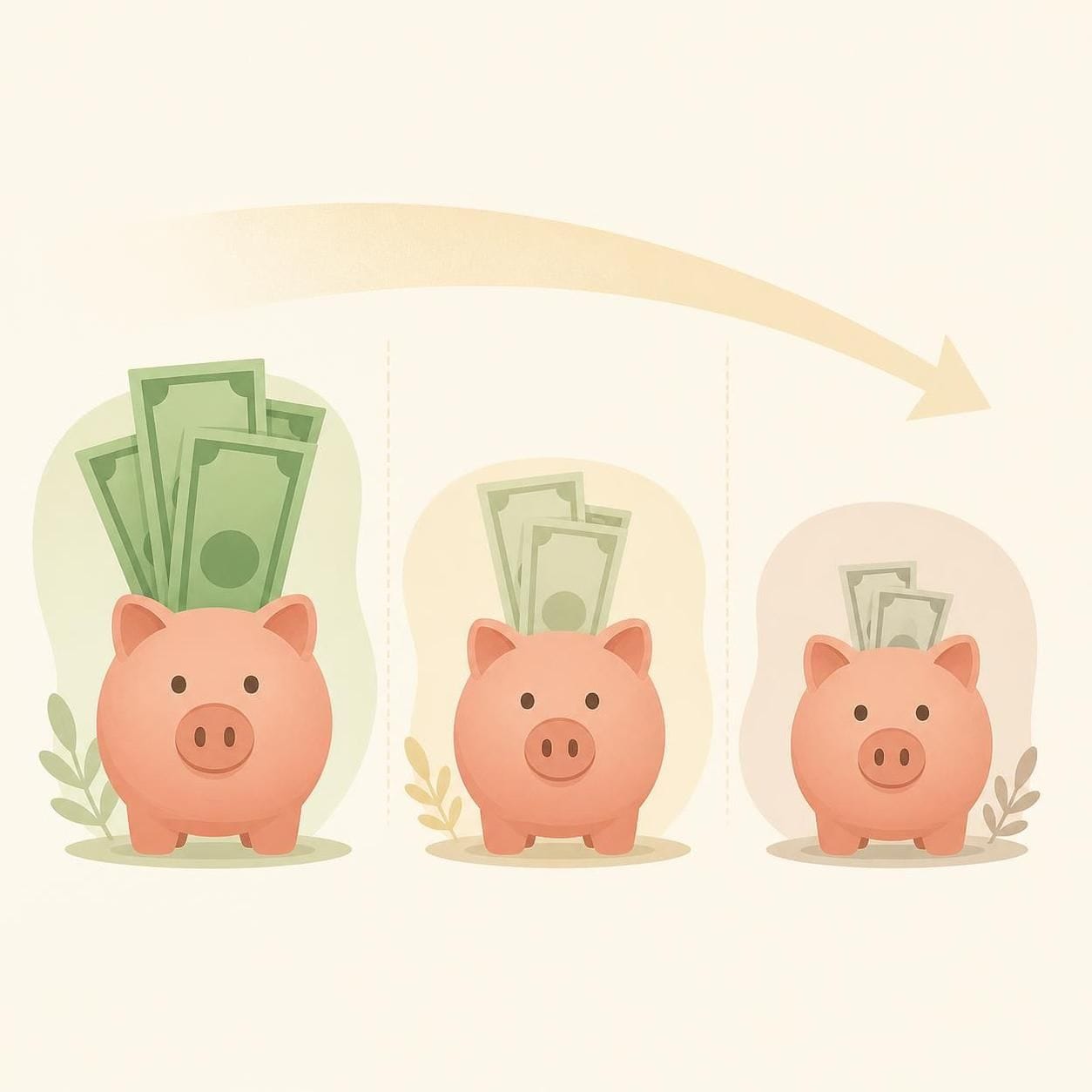
1. Your purchasing power shrinks
If the IPCA accumulates 4.58% over 12 months, a grocery cart that used to cost R$ 1,000 now costs, on average, about R$ 1,045.80. Your salary didn't go up, but the cost of living did — meaning you buy less with the same amount.
2. Idle money loses value
R$ 1,000 kept at home is still R$ 1,000 a year from now, but it buys the equivalent of about R$ 956 in today's terms (considering the 4.58% cumulative figure). That's why leaving money sitting idle is a silent way of losing money.
3. Investments need to "beat" inflation
What matters in an investment is the real return — what's left after subtracting inflation. If an investment yields 4% per year and inflation is 4.58%, the real return is negative: you gained nominally, but lost purchasing power. That's why there are investments indexed to the IPCA, such as Tesouro IPCA+ (an IPCA-linked Treasury bond), which pay the inflation variation plus an agreed interest rate.
4. The Selic rate reacts to inflation
When the IPCA stays persistently above the target, the Central Bank tends to raise the Selic rate to cool consumption and contain prices. This makes credit more expensive (financing, credit cards, overdraft) — but it also improves fixed income returns. Understanding this relationship helps you understand why your financing costs rise and fall.
What to do in practice
- Don't leave money idle: even your emergency fund should be in a daily-liquidity investment that yields at least close to inflation — keeping in mind that, for an emergency fund, liquidity and capital preservation can take precedence over returns. See how much to keep in an emergency fund.
- Compare returns against inflation: before celebrating a return, subtract the period's inflation. The fixed income guide explains how indexers work.
- Review your budget often: prices rise at different paces. Reviewing your spending helps identify where inflation is hitting hardest. The step-by-step is in how to build a family budget.
- Start small, but start: investing early, even small amounts, puts the power of compound interest to work in your favor — and it's the best long-term defense against inflation.
Common mistakes about inflation
- Thinking that low monthly inflation means prices are falling. Inflation of 0.82% means prices still went up — just less.
- Comparing the monthly number with the cumulative figure as if they were the same thing. They cover different time windows.
- Ignoring inflation when evaluating investments. A high nominal return can mean a low or negative real return.
- Leaving money idle "for safety." Without market risk, there's the certain risk of losing purchasing power.
FAQ
Is the IPCA the only inflation index in Brazil? No. There are others, such as the IPCA-15 (a preview of the IPCA), the INPC (focused on minimum wages and lower income brackets) and the IGP-M (used in some rents). But the IPCA is the main one and the official index for the inflation target.
Who calculates the IPCA? The IBGE (Brazilian Institute of Geography and Statistics). Historical data is available at the Central Bank through series SGS 433 (monthly) and SGS 13522 (12-month cumulative).
How often is the IPCA released? Monthly, usually in the first half of the month following the measured period.
Can the IPCA be negative? Yes. When average prices fall over the period, the index is negative — this is called deflation. It's rare, but it has happened in Brazil.
Which investment protects against inflation? IPCA-indexed bonds, such as Tesouro IPCA+, are designed for that: they pay the inflation variation plus an agreed rate. But every investment has its own risks, costs and taxes — it's worth studying before choosing.
Conclusion
The IPCA is Brazil's official inflation thermometer: in September 2026, it came in at 0.82% for the month and accumulated 4.58% over 12 months. Understanding the difference between these two readings — and what inflation does to your purchasing power — is the first step to protecting your money. The practical rule is simple: idle money loses value; invested money needs, at minimum, to beat inflation to preserve (and ideally grow) your purchasing power over time.
Disclaimer: this content is educational and does not constitute individual investment advice. Inflation data refers to September 2026 and may be revised by the IBGE; check the latest figure before making decisions. Every investment involves its own risks, liquidity conditions and taxation.

