
Overdraft (Cheque Especial): how it works, what it costs, and when (not) to use it


The overdraft (known in Brazil as "cheque especial") is a revolving credit line attached to your checking account: the bank makes a pre-approved limit available, and when your balance goes negative, the facility is automatically activated, with interest charged daily only on the days you actually use it. It is one of the most expensive forms of credit on the market — under a Central Bank rule, interest rates for individuals are capped at 8% per month, equivalent to roughly 151.82% per year. In this guide, you'll understand how it works in practice, what it really costs, which rules protect consumers, and when it makes sense to use it — or avoid it.
What the overdraft is and how it works
The overdraft (also called an account limit or "automatic overdraft") works like this:
- The bank pre-approves a credit limit attached to your checking account.
- If you make a payment or withdrawal without sufficient funds, the bank automatically covers the difference.
- Interest at a pre-set rate is charged on the amount used, day by day, for as long as the debt exists.
- When money comes into the account (salary, transfer, PIX), the deposit automatically pays down the outstanding balance.
In other words: it isn't "your" money, nor an extension of your salary. It's a loan you take out without signing anything — which is why it catches so many people by surprise at the end of the month.
What it costs: interest and IOF
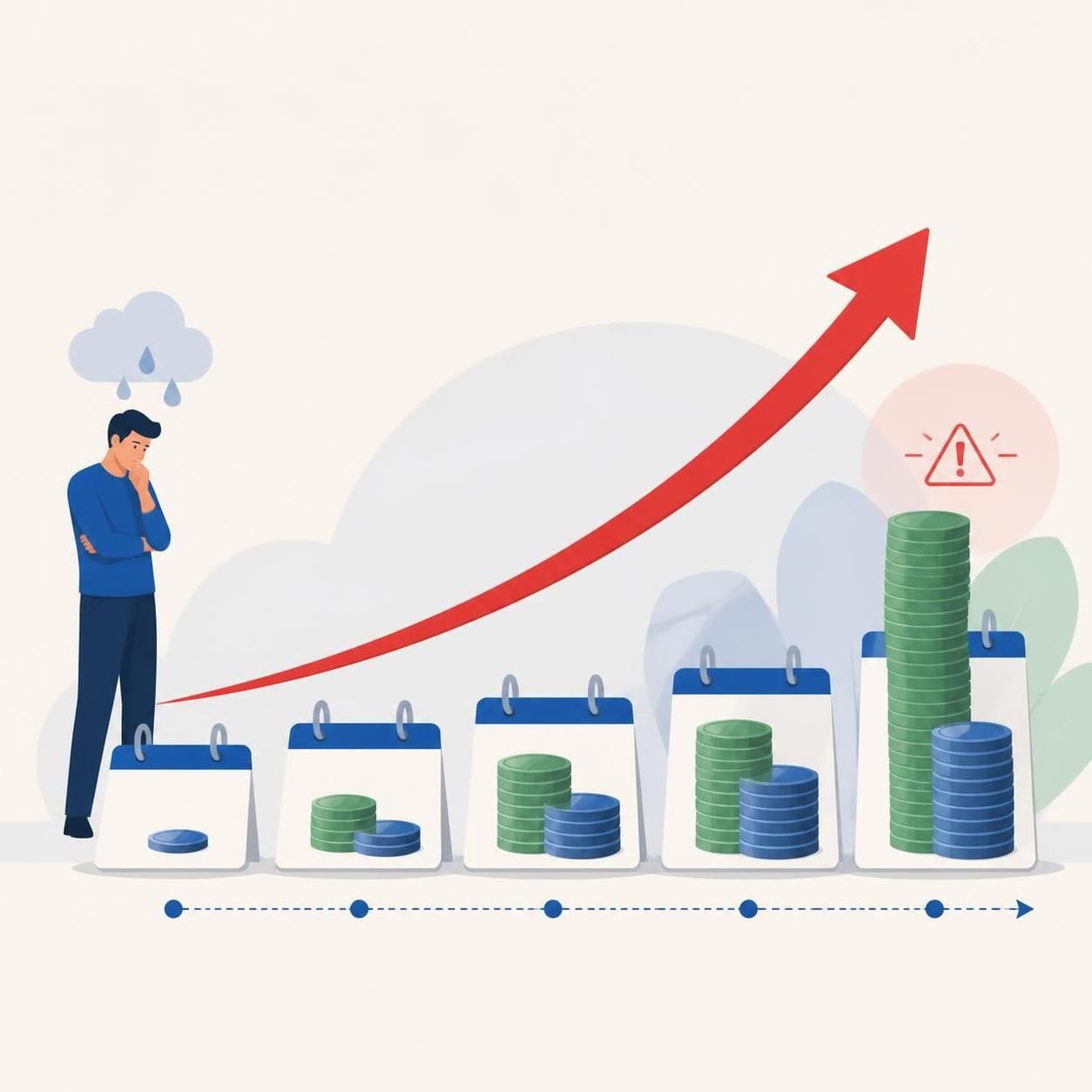
Interest: the cap is 8% per month
Under a Central Bank rule (CMN Resolution 4,765/2019), overdraft interest for individuals is capped at 8% per month (151.82% per year). This rule has been in effect since January 6, 2020.
According to a Procon-SP survey (June 2026, collected on 06/02/2026 from 6 major banks), the average overdraft rate was exactly 8% per month — meaning that, in practice, many banks charge the maximum allowed. For comparison, the average personal loan rate in the same survey was 8.36% per month (162.17% per year), considering different terms and charging periods.
Numerical example (explicit assumptions): if you use R$ 1,000 of your overdraft and go 30 days without paying it off, at 8% per month you'll owe about R$ 1,080 — not counting IOF. If you roll the balance over for 6 months without amortizing it, compound interest takes the debt to nearly R$ 1,587. That's why the overdraft should be treated as a solution for a few days, not as monthly financing.
IOF
In addition to interest, overdraft use is also subject to IOF, the tax on financial transactions, which is added to the outstanding balance. The exact percentage varies according to the rules in force — check your bank's app or your contract before using it.
Is a fee charged merely for having an overdraft limit?
No, not for individuals or microentrepreneurs (MEI). Brazil's Central Bank states that financial institutions may not charge these customers for simply making an overdraft limit available. The previous 0.25%-per-month provision must not be described as an optional charge currently allowed for these customers. See the Central Bank's official FAQ, question 3. Interest on the credit actually used and the IOF tax are separate costs.
Rules that protect consumers
- Limit reduction: normally the bank gives at least 30 days' prior notice. Exception: if the customer's credit-risk profile deteriorates, the limit may be reduced without that 30-day period, with communication no later than the reduction.
- Limit increase: the bank can only increase the amount with your prior authorization. No increase happens "on its own."
You can also ask the bank to reduce (or deactivate) your limit in writing or through the app — a practical measure for anyone who knows they tend to use the limit impulsively.
Overdraft vs. personal loan vs. other alternatives

| Criterion | Overdraft | Personal loan | Credit card (revolving) |
|---|---|---|---|
| How it's taken out | Automatic, no paperwork | Request and credit analysis | Automatic when the bill goes unpaid |
| Procon-SP rates (June 2026) / statutory credit-card ceiling | Average rate: 8.00% p.m. (~151.82% p.a.) | Average rate: 8.36% p.m. (~162.17% p.a.) | Accumulated interest and financial charges capped at 100% of the original debt (debts originated from Jan 3, 2024); not a monthly interest-rate cap |
| IOF | Yes | Yes | Yes |
| Best use | A few days' emergency | Planned expense with a longer term | Avoid — pay the bill in full |
Note: the Procon-SP comparison considers different charging periods (30 days for the overdraft vs. 12 months for the personal loan) and a sample of 6 banks; rates vary by institution and customer profile. For revolving credit-card debt, the 100% ceiling applies to total accumulated interest and financial charges relative to the original debt, not to a monthly rate. Source: Central Bank of Brazil.
When (not) to use the overdraft
It can make sense to use when:
- there's a short-term timing gap (e.g., a bill is due today and your salary lands in 3 days);
- the amount is small and you already know exactly when you'll pay it off;
- no alternative is available at that moment.
Avoid when:
- the debt will last weeks or months — a personal loan usually has a lower total cost for longer terms;
- you use it every month — that's a sign of a blown budget, not a lack of limit;
- the alternative is dipping into your emergency fund for convenience — it's worth reading about how much to keep in an emergency fund before deciding what to prioritize.
Common mistakes
- Treating the limit as available money. The "total" balance in the app includes credit, not wealth.
- Rolling the debt over for months. At 8% per month, the balance doubles in about 9 months if nothing is paid down.
- Ignoring IOF and any legally applicable charges when calculating the real cost.
- Swapping the overdraft for credit card revolving debt without comparing — both are expensive; a personal loan is usually better for longer terms.
- Not negotiating. Banks often offer better terms to pay off or transfer the debt — ask.
FAQ
Is there an interest rate cap on the overdraft? Yes. Under a Central Bank rule (CMN Resolution 4,765/2019), the cap for individuals and MEI (micro-entrepreneurs) is 8% per month (151.82% per year), in effect since January 2020.
Does using the overdraft hurt my credit score? Using it isn't a problem in itself; carrying a negative balance for a long time and missing commitments can affect your history. Learn more about how credit scores work.
Can the bank cut my limit without notice? Normally, 30 days' prior notice is required. When the customer's credit-risk profile deteriorates, the bank may reduce the limit without waiting 30 days, provided it communicates the decision no later than the reduction. Increasing the limit requires prior authorization. See the Central Bank FAQ, question 9.
Overdraft or personal loan: which is cheaper? It depends on the term. For a few days, the overdraft can cost less because interest is charged only on the days of use. For longer terms, a personal loan tends to have a lower total cost — compare the total effective cost (CET) before deciding.
Do I have to pay a fee just for having a limit? No: for individuals and MEIs, the Central Bank prohibits fees for merely making the overdraft limit available. Interest on amounts used and IOF are different charges.
Conclusion
The overdraft is an emergency tool for days, not an income supplement. With a cap of 8% per month, it's one of the most expensive forms of credit on the market: use it only to cover short timing gaps, pay it off as soon as money comes in, and if the need keeps recurring, address the cause — reorganize your budget (the 50-30-20 method can help) or consider a personal loan with a planned term. This is educational content; it is not individual credit advice. Interest rates, fees, and IOF vary by institution and may change.
Related articles:

